

[ad_1]

ZDNET’s key takeaways
- A power station built to survive the cold and be safe to use and charged below freezing.
- The power station has a 1,500 W output, and can power a vast array of appliances.
- You are paying a price — both in size, weight, and dollars — for sodium-ion batteries, so consider if being able to handle low-temperatures is important to you.
Follow ZDNET: Add us as a preferred source on Google.
Cold weather is a lithium battery killer. And when I say cold can kill batteries, I mean it.
Without some form of heating, lithium-ion cells begin to struggle to deliver power once temperatures drop below 32°F (0°C). By the time temperatures hit 5°F (-15°C), the battery’s capacity can be reduced by 30%-40%, depending on factors such as the battery’s age and quality. This loss of capacity can cause devices relying on these batteries to malfunction.
The situation is even worse when it comes to charging.
Charging lithium-ion batteries at or below 32°F (0°C) can cause permanent damage due to a process called lithium plating. This occurs when lithium metal is deposited on the surface of the battery’s anode instead of being properly absorbed into the material. At best, this process can kill the battery. At worst, it can cause short circuits or even fires.
Also: Need power at the campsite? This portable battery station has several days worth
Every time you expose your power station to low temperatures, you’re essentially playing Russian roulette with both the hardware and your safety.
Bluetti has a solution: the Pioneer Na, a power station that replaces lithium-ion cells with cold-proof sodium-ion technology.
Best generators deals of the week
Deals are selected by the CNET Group commerce team, and may be unrelated to this article.
It truly shines in the cold
The Pioneer Na has a 1,500 W power output and a capacity of 900 Wh. It features all the usual ports and outlets you’d expect — four 120 V 1,500 W AC outlets, four 15 W USB-A ports, a 100 W USB-C port, a 12 V/10 A car outlet, and even a 15 W wireless charging pad.
Plenty of ports for all your gadgets!
Adrian Kingsley-Hughes/ZDNET
The unit can be charged using AC, solar panels, or a vehicle’s 12V system. Using AC, you can charge the unit from flat to 80% in just 45 minutes under ideal conditions and fully charge it in under an hour.
The Buetti Pioneer Na with banana for scale.
Adrian Kingsley-Hughes/ZDNET
In terms of capacity, this power station can run your refrigerator for close to a day, keep your Wi-Fi router powered for a couple of days, recharge your laptop nearly a dozen times, and keep your electric kettle running for an hour or two.
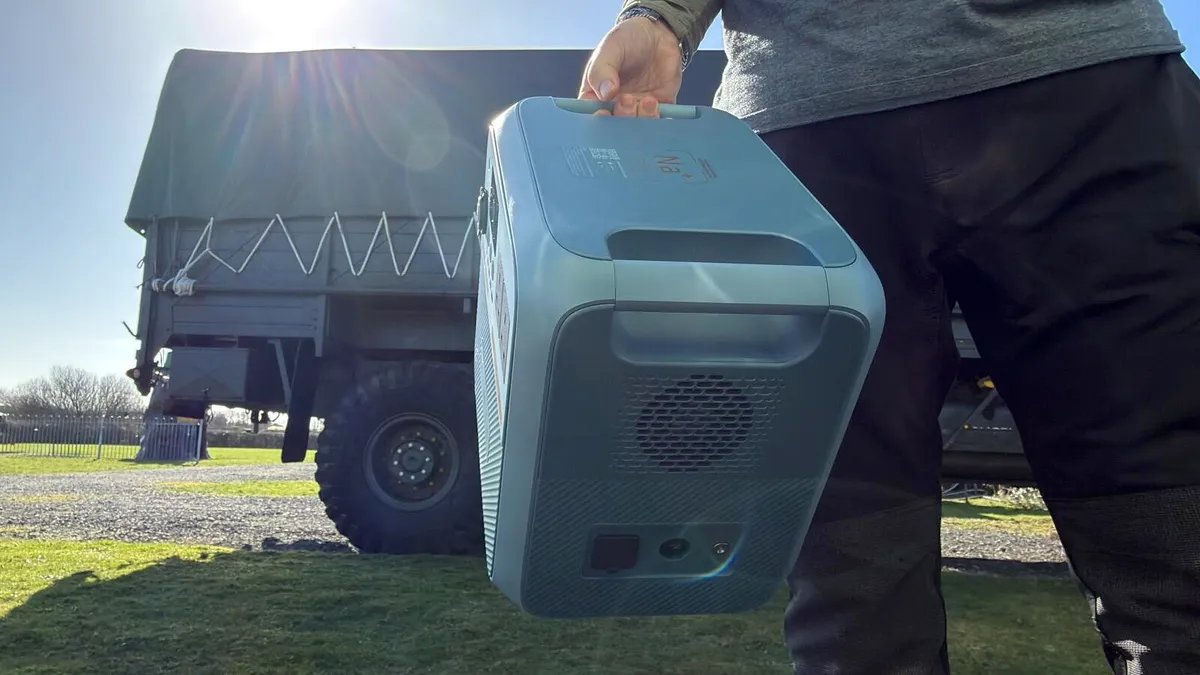
The Buetti Pioneer Na is compact yet hefty.
Adrian Kingsley-Hughes/ZDNET
This isn’t a small unit. At 13.4 x 9.7 x 12.5 inches and 35.3 pounds, it’s a hefty device, bigger and heavier than the 1,800 W/1,024 Wh Bluetti Elite 100 V2 (this measures 12.6 x 8.5 x 9.8 inches and weighs only 25 pounds). A big part of that size and weight comes from the sodium-ion batteries inside.
There are pros and cons to switching to sodium-ion battery technology. The biggest downside is that sodium-ion batteries aren’t as energy-dense as their lithium counterparts. However, the positives include being cheaper, safer, more sustainable, and having a longer cycle life. According to Bluetti, these batteries can handle 4,000 charge cycles and offer a 10-year lifespan. Most importantly, they perform much better in freezing temperatures.
Also: Aferiy P280 review: A multifunctional power station that I’d use for emergency backup
It’s in cold conditions that these batteries truly shine. The cells in the Pioneer Na can be safely charged at temperatures as low as 5°F (-15°C) and can operate down to a frosty -13°F (-25°C). While power output is slightly reduced at these low temperatures, the unit can still maintain 80% of its discharge capacity. This means it can deliver the full 1,500 W to devices over AC, with only the surge or lifting power support being limited.
Testing the Pioneer Na
To test how well the Pioneer Na handles the cold, I placed it in a commercial freezer set to -12°F (-24°C) to chill. The unit sat there for about 26 hours, so it got to that deep cold spot, but as soon as I plugged something in, it performed flawlessly. I even tested it powering a hefty heater (located outside the freezer), and it ran it with no issues at all.
Also: I’ve tested dozens of power stations – this one handled at everything I threw at it
Try that with your standard power station — actually, don’t.
Chilling at −12°F for over a day.
Adrian Kingsley-Hughes/ZDNET
When temperatures swing the other way, the Pioneer Na also features a smart cooling system, allowing it to operate in conditions as hot as 104°F (40°C).
But there’s more
Most power stations see limited use, and I’ve heard from many owners who needed their power station only to find it partially or fully discharged. This happens because even when devices are off, they still consume a small amount of power. This is called standby power or no-load consumption, and it’s necessary for functions such as detecting button presses, monitoring ports, or maintaining wireless connectivity. While it’s always a good idea to check and top up your power station regularly, the Pioneer Na makes this less critical thanks to its super-low standby power consumption of just 1.5 W.
Also: This off-grid internet system is my secret weapon for winter storm outages
Bluetti has really built the Pioneer Na to perform.
Fast AC charging is another great feature, especially during emergencies when you might have to get ready fast.
Adrian Kingsley-Hughes/ZDNET
ZDNET’s buying advice
There’s no doubt that the lithium-ion battery has become the engine driving so many of our gadgets in the 21st century. For the vast majority of use-case scenarios, it’s the perfect technology. However, there are situations where a different battery technology would be better suited — and cold weather applications are one of those. I’ve seen power stations fail in the cold, so this is a real problem.
Also: The best cheap portable power stations of 2026: Expert tested and reviewed
The Bluetti Pioneer Na definitely fills a gap in the market by addressing this issue. That said, you’re paying a price — both in extra dollars, size, and weight — for this feature. There are smaller, lighter, cheaper, and higher-capacity power stations available, such as the Bluetti Elite 100 V2 on the market.
[ad_2]
Source link
