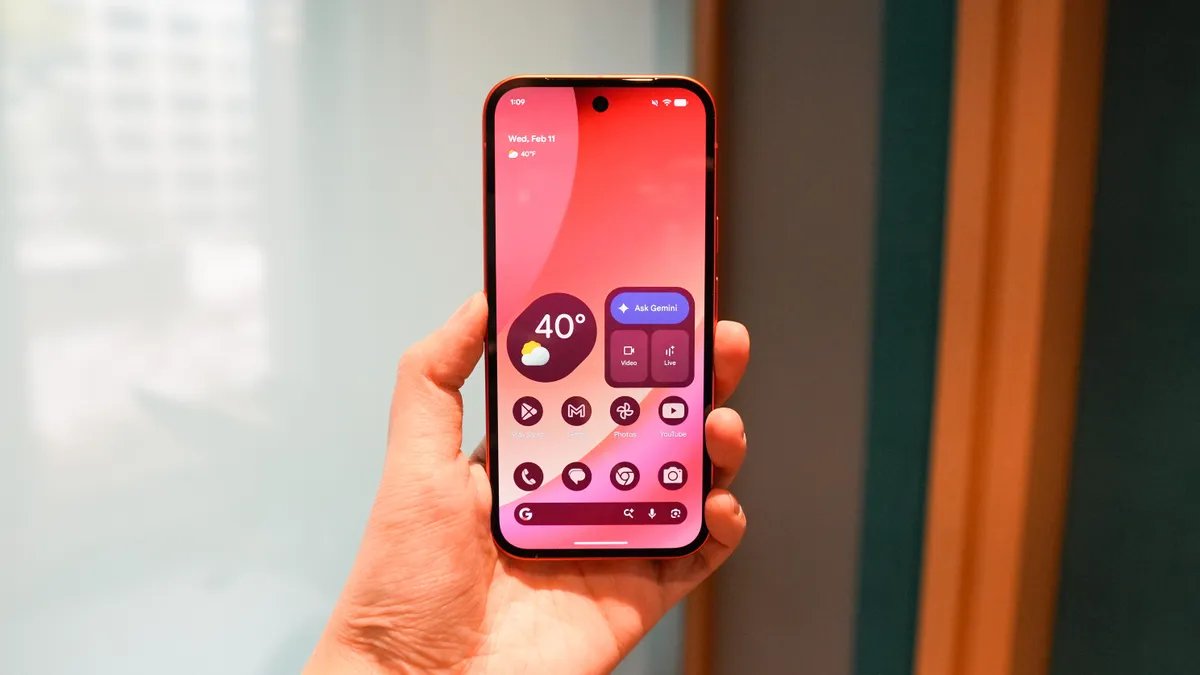

pros and cons
- Faster charging and a flush camera bump are appreciated.
- Durable material choices and long software update support.
- One of the remaining ‘small' phones with a good camera and battery life.
- No PixelSnap to compete with iPhone 17e.
- 8GB RAM and Tensor G4 are showing their age.
more buying choices
Follow ZDNET: Add us as a preferred source on Google.
As I made my way through the halls of MWC Barcelona this week, the Google Pixel 10a was sitting comfortably in my jeans.
The $499 handset is not as powerful, capable, or expensive as the other phones on the show floor, but it's one of the few options that I can confidently recommend — and one of the even fewer that can fit into my denim pockets without making me feel self-conscious.
Also: Best of MWC 2026: We found the biggest news from Lenovo, Xiaomi, Honor, and more
Like last year's Pixel 9a, the Pixel 10a is Google's safest (and best) bet at appeasing midrange market customers. The Pixel 10a is, for the most part, the same phone, from the design to the camera setup to the processor. But Google has made some smaller changes that make the sum of the Pixel 10a's parts even more worthwhile in 2026.
Design: Find the difference
It's debatable, but the biggest of the small design changes this year, to me, is a fully flush camera. While no one really complained about the degree of the Pixel 9a's camera protrusion, the complete lack of it on the Pixel 10a makes holding it feel more elegant than any other device I've used recently.
(It's also just one big design flex by Google, and I'd really like to see it take a similar approach with its flagship series, expected later this year.)
Also: Google Pixel 10a vs. Pixel 10: I compared the two midrange phones, and this model wins
Google has improved the Pixel 10a's display, boosting its peak brightness to 3,000 nits (from 2,700). Again, a small change on paper that's more noticeable during real-world usage. Barcelona has been generous with sunshine and the occasional overcast the past few days, but I've still been able to navigate diamond-shaped streets and random passages without squinting at my phone.
The Google Pixel 9a (left) and the Pixel 10a (right). See the difference?
Kerry Wan/ZDNET
That said, Google's brightness slider still feels… imbalanced. Compared to Samsung devices and iPhones, I find myself hovering the brightness slider between the 75% and 100% levels during the daytime.
On the Samsung Galaxy S26 Ultra in my other pocket, which has a lower peak brightness of 2,600 nits, I'm comfortable at around 60%. To be clear, this all comes down to the sensitivity that Google sets, so I'm not knocking the actual display technology. I'm literally nitpicking.
Also: How Qualcomm's new wearables chipset could spell the end of smartphone dominance
What I will knock Google for is the lack of Qi2 wireless charging — or, more specifically, the magnetic adapters that make up the rest of the Pixel 10 series' PixelSnap feature. That's clearly been a fan-favorite feature among Pixel Superfans and, more importantly, is a convenience that could possibly sway iPhone users over to Android. (The fun, poppy Berry color is second on my list of reasons to switch. I digress.)
Frankly, it's crucial that Google positions the Pixel 10a as firmly as possible as the leading midrange option on the market, as the new iPhone 17e has arrived to compete in the same space. And what's one of the best new features on the iPhone? MagSafe support.
Performance: In this memory economy?
Not just Google, but every consumer electronics release this year will be set against the backdrop of “RAMageddon,” as the AI boom and its ever-increasing demand for high-bandwidth memory cause shortages and rising prices.
Also: Google Pixel 10a vs. Pixel 9a: How much of an upgrade is the new affordable phone?
Perhaps that's partly why Google, like Apple and the iPhone 17e, stuck with the same design and memory configuration as last year's phones. The cost savings are reasonable. I was just hoping for something more refreshing.
While the Pixel 10a's Tensor G4 chip, 8GB of RAM, and 128GB of base storage could pass for a competent phone a few years ago, the higher demands of today's users — including increased use of on-device and multimodal AI features, as well as content capturing — prove you can no longer settle for “good enough.” Not when Google is advertising the phone with its seven-year commitment to software and security updates.
Gemini Live, for example, has had its struggles during my MWC trip, such as formulating responses before I even finish asking questions, or not responding at all. In one instance, the live camera feed stuttered because an Uber ride was being tracked in the background. I partly blame my wonky eSIM connection in Barcelona for that, so I'll give the Pixel 10a another shot now that I'm back in New York.
Also: Verizon will give you Google's newest Pixel 10 model for free right now – how to qualify
On a brighter note, the 5,100mAh battery on the Pixel 10a has held up well throughout a week of intense multitasking, lasting just long enough to be topped up after my dinners. The improved 30W wired charging rate won't set any records, but it's a meaningful step-up from last year's 23W speed.
Cameras: It's all about the software
The Pixel 10a features the same camera hardware as the Pixel 9a, meaning it has a 48MP wide lens and a 13MP ultrawide lens on the rear, and a 13MP sensor on the front. Like last year, the Pixel camera delivers on color accuracy and contrast balancing across various lighting conditions. Compared to competing phones like the Samsung Galaxy A56 5G, I found the Pixel 10a's output leaned toward cooler tones, which I prefer.
Captured with the main wide lens (left) and ultrawide (right), with the help of Camera Coach.
Kerry Wan/ZDNET
How the Pixel 10a camera experience truly differentiates itself year over year is through the AI assistance of Auto Best Take and Camera Coach, two guidance features that have been trickled down from the more expensive Pixel 10 models. The former analyzes repeated shots and compiles one with the best expressions, like a group photo with everyone smiling and no blinking. Camera Coach gives you suggestions for framing your shots based on the subject.
Also: Get the new Google Pixel 10a for $4/month at AT&T (plus free Pixel Buds)
My experience with both AI features has been positive, and I can see them being relied on by family and friends who feel unconfident about their camera skills, but are willing to learn.
ZDNET's buying advice
That's to say, the Google Pixel 10a continues the company's streak of value-driven phones with smart and meaningful upgrades. While I wish Google was more ambitious with the Pixel 10a's performance specs to meet the growing demands and increased ownership times of today's users, the device should still hold up well for most people.
Also: I changed 9 settings on my Pixel phone to dramatically improve the camera quality
Notably, the $499 Pixel 10a configuration offers 128GB of storage. If that's not enough, you'll have to spring up for the 256GB variant, which costs $599, the same as the iPhone 17e. I'll have to test the iPhone to see which one is truly better at that price, but for now, the choice is clear if you're settled on Team Android.