

[ad_1]

Follow ZDNET: Add us as a preferred source on Google.
ZDNET’s key takeaways
- OpenAI reframes images as a visual language.
- Thinking mode builds context-aware infographics.
- Brand fidelity is still inconsistent in early testing.
Today, OpenAI announced ChatGPT Images 2.0, its next-generation image model, which the company says is focused on precision, usability, and complex visual tasks.
The most notable new capability is the ability to combine text and images to build complex, beautiful pages. OpenAI is reframing the whole idea of image generation from a process that creates decorations (their word) to a language (also their term).
Also: The best AI image generators of 2026: There’s only one clear winner now
OpenAI describes it as, “A good image does what a good sentence does — it selects, arranges, and reveals. It can explain a mechanism, stage a mood, test an idea, or make an argument.”
Thinking capabilities enable complex workflows
In addition to its vastly improved ability to mix text and graphics, the new model uses enhanced thinking capabilities. It can generate multiple images per prompt with continuity across outputs. This approach is possible because the model actually integrates reasoning into the image output.
This shift is big. Instead of just producing an image that pretty much matches the prompt details, Images 2.0 can take a much vaguer prompt, like “Generate an infographic about activities I should do with tomorrow’s weather in San Francisco in mind.”
Also: How to switch from ChatGPT to Gemini
From this prompt, the AI will gather weather and activity data about San Francisco, determine activities appropriate to the weather, and then build an image or set of images that fit the results.
According to OpenAI, “In this model, Images 2.0 acts more like a visual thought partner, helping carry a project from rough concept to finished asset with significantly less work on your part.”
Precision and design control improve usability
Many of us have long struggled to convince ChatGPT to generate images in a specific desired aspect ratio. Often, the AI stubbornly produces what it wants. But now, with Images 2.0, the model has support for “aspect ratios as wide as 3:1 and as tall as 1:3.”
The model also supports higher-fidelity outputs that (mostly) produce accurate object placement, detailed text rendering, and complex compositions. We’ll see if we can remove the word “mostly” from that sentence after the product is officially released.
Also: I tried Personal Intelligence, and it was accurate (but unsettling)
The AI also supports small text, UI elements, and stylistic constraints at up to 2K resolution. Cool.
Testing the preview
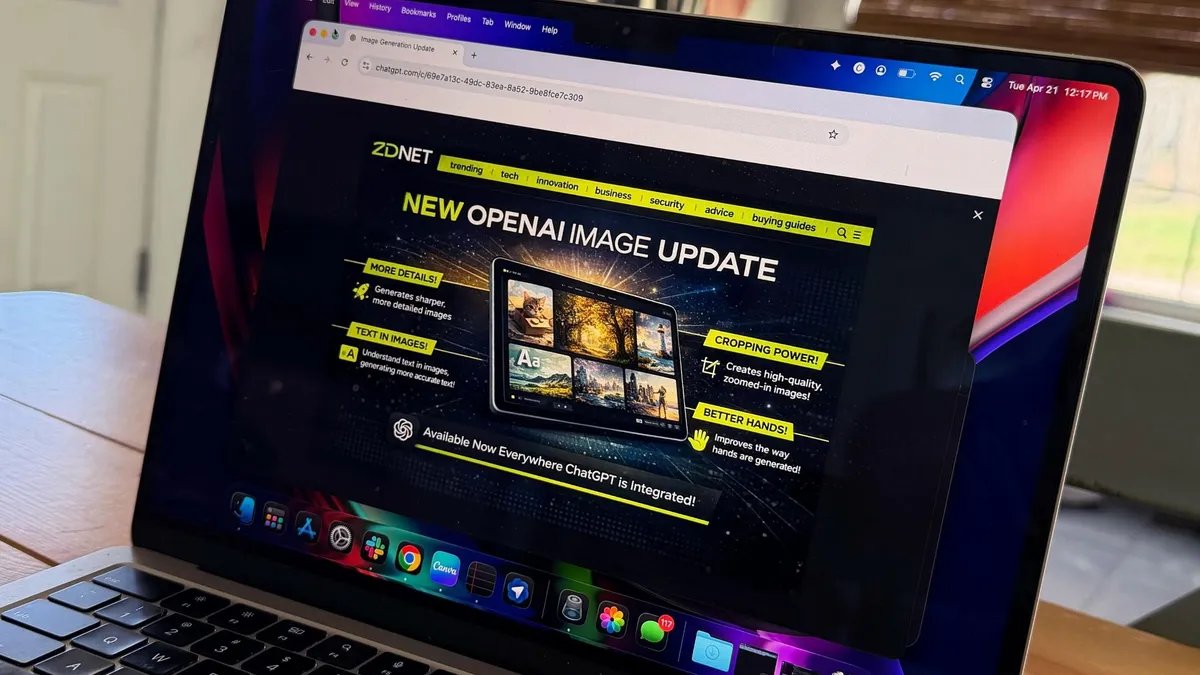
I was given access to a day-before-release preview, and the model is impressive, mostly. I fed it a screenshot of the ZDNET home page and a draft of the Images 2.0 press release.
Then I instructed, “Based on the contents of the press release, generate a 16:9 infographic about the new image update and generate it using the ZDNET brand style as shown in the ZDNET home page document.”
Also: I tried Google Photos’ new AI Enhance tool: How it crops, relights, and fixes your shots – sometimes
The model did a great job on the infographic, but try as it might, it could not reproduce the ZDNET logo. On its first try, it rendered the Z in ZDNET with a slight droop.
I tried a variety of requests on the order of, “Fix the ZDNET Logo. The Z droops in your version but is not droopy in the actual logo.” But Images 2.0 never managed to fix it.
So I started a new session. This time, I included the instruction, “Use special care to reproduce the ZDNET logo accurately.”
Also: I tested ChatGPT Plus vs. Gemini Pro to see which is better – and if it’s worth switching
Here’s where things got very odd. For its first run, the model somehow dug up a copy of ZDNET’s logo from before our 2022 redesign. This logo is nowhere to be found on our current home page. Weirdly, it rendered that old logo using the current color scheme. The model then pushed the logo and the infographic information off the left edge of the image. It also chose a light blue for “Images 2.0” that’s not a ZDNET brand color.
I tried mightily to convince it to use the current logo. I managed to get it to push the image to the right, so nothing was cut off. But adding the prompt, “Use the ZDNET logo that is on the provided page. Do not search for an alternative logo,” did nothing to fix the problem.
I took one more shot at the challenge before deciding to go back to finishing up this article. Once again, I started a new session so the AI didn’t have muscle memory from its previous miscalculations.
Also: This powerful Gemini setting made my AI results way more personal and accurate
The model messed up the logo again. This time, the AI decided to add a rudder shape to the stem of the stretched-out capital D.
To be fair, I’m using a pre-release version of Images 2.0. I’ll be back with a much more comprehensive test run of the model after the official product release.
I also tried a similar test using a different document with Google’s Nano Banana Pro, but because it didn’t handle the synthesis the way that this new version of OpenAI’s product does, it wasn’t really able to repeat the results I got here. We’ll know more as we do more advanced tests
Pricing and availability
The new model is available today to all ChatGPT and Codex users. Advanced outputs and the thinking capability are available to ChatGPT Plus, Pro, Business, and Enterprise users. Be sure to select “Thinking” from the ChatGPT dropdown bar at the top of the screen.
At the time of writing, before release, the new Images 2.0 model is only available on the desktop. But OpenAI promises that these capabilities will be in the mobile version as well, along with the ability to finger-select images using your mobile touchscreen.
The images are also available via API using the gpt-image-2 model. API pricing varies depending on the quality, thinkiness (my word), and desired image resolution.
If an AI can handle layout and content in combination, will that change how you approach design projects? Let us know in the comments below.
You can follow my day-to-day project updates on social media. Be sure to subscribe to my weekly update newsletter, and follow me on Twitter/X at @DavidGewirtz, on Facebook at Facebook.com/DavidGewirtz, on Instagram at Instagram.com/DavidGewirtz, on Bluesky at @DavidGewirtz.com, and on YouTube at YouTube.com/DavidGewirtzTV.
[ad_2]
Source link
