


[ad_1]
The pain for Bitcoin [BTC] bulls may be nearing its end.
Notably, Bitcoin’s latest on-chain data suggests the market is entering the final stage of its bearish phase. During this period, investors typically realize heavy losses as they sell below their cost basis. As this selling pressure fades, Bitcoin has historically found a bottom before rebounding.
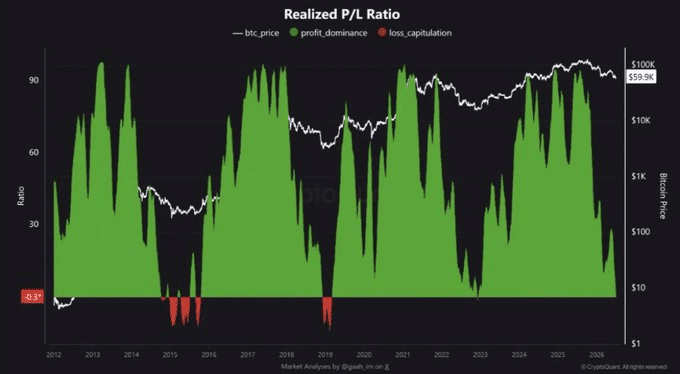
Supporting this view, Bitcoin’s Realized P/L Ratio has fallen to -0.35, its lowest level in 43 months. The indicator measures realized profits against realized losses. A deeply negative reading shows that losses are dominating, signaling widespread capitulation. In previous market cycles, similar levels have often coincided with major Bitcoin bottoms, making the metric a closely watched signal for long-term investors.
The shift in ETF flows also supports this view, suggesting that selling pressure may be easing.
In the latest trading session, U.S. spot Bitcoin ETFs recorded $223 million in net inflows, marking a return of institutional demand after recent outflows. Most of the capital flowed into FBTC, which attracted $166 million, followed by ARKB with $91.8 million, indicating that investors are once again allocating capital to BTC through regulated investment vehicles.
This supports the view that Bitcoin may be entering the final stage of its bear cycle. While on-chain data still shows elevated unrealized losses, the return of ETF inflows indicates demand is starting to match supply. If this trend holds, Bitcoin’s $60k support could strengthen, improving the chances of a recovery in Q3.
However, one key metric highlights that the recovery is not yet fully supported.
Bitcoin’s recovery hinges on whether liquidity can catch up
The market continues to face a liquidity constraint.
In a typical bull market, stablecoin supply expands as new capital enters the crypto ecosystem. That additional liquidity increases buying power, helping absorb selling pressure and sustain higher prices.
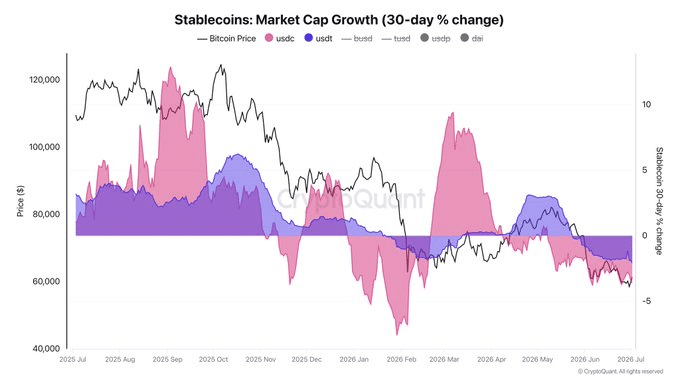
This time, however, the pattern is different. Despite the return of ETF inflows, liquidity continues to contract, with $1 billion+ leaving the market this week alone. Over the past thirty days, the market cap of USDC and USDT have fallen by 3.6% and 2%, respectively, extending a trend that has persisted since November 2025. The divergence suggests that while demand is improving, the market liquidity is not.
This makes Bitcoin’s leverage profile increasingly important.
Following the recent deleveraging event, Bitcoin has re-entered the “slight leverage” zone, indicating that traders are rebuilding leveraged positions as confidence in a market bottom grows. However, leverage is increasing while market liquidity continues to contract.
If stablecoin liquidity continues to decline, there may not be enough spot demand to support the rally. Therefore, Bitcoin could become more vulnerable to a liquidation-driven correction as leveraged positions build.
As a result, Bitcoin’s Q3 rally could struggle to sustain its momentum, leaving it exposed to sharp pullbacks.
Final Summary
- Bitcoin’s bottom signals are improving as ETF inflows return and on-chain metrics point to easing selling pressure.
- Weak liquidity remains the biggest risk. If stablecoin flows don’t recover, Bitcoin’s Q3 rally could struggle to hold its momentum.
[ad_2]
Source link
