

[ad_1]

System76 Thelio Mira Custom
pros and cons
- All the power you could ever want.
- Great, quiet design that’s easy to repair or add to.
- The Linux workstation of your dreams.
Follow ZDNET: Add us as a preferred source on Google.
Sure, you could build a more powerful Linux workstation, but even then, you’d be hard-pressed to make a better machine than System76‘s new 2026 Thelio Mira Custom desktop PC. That’s because the computer is both very powerful and quiet as a whisper.
The 2026 Mira refresh is built around AMD’s Ryzen 9000 “Granite Ridge” platform on an X870 motherboard. This setup gives you PCIe 5.0 for GPUs and SSDs, providing up to 32 gigatransfers per second (GT/s) per lane, which adds up to 64 gigabytes per second (GB/s) and 128 GB/s of bidirectional throughput. Combine that power with Gen5 Non-Volatile Memory Express (NVMe) sequential throughput of up to 15 GB/s, and we’re talking seriously fast I/O.
Also: The best all-in-one computers of 2026: Expert tested and reviewed
That’s a good thing, because the Mira Custom CPU options range from a 6-core Ryzen 5 9600X at the low end up to a 16-core Ryzen 9 9950X or 9950X3D, with boost clocks advertised up to 5.7 GHz on the top SKUs. In my case, I had a 16-core Ryzen 9 9950X that ticked along at 4.3 GHz. When I put the pedal to the metal, it zipped along at 5.7 GHz.
Best desktops deals of the week
Deals are selected by the CNET Group commerce team, and may be unrelated to this article.
For graphics, I could have used the Ryzen’s integrated graphics, but my PC also came with an Nvidia GeForce RTX 5070 with 12 GB of VRAM. That capability is fine for today’s 1080p/1440p games, but it’s not enough VRAM for top-of-the-line 4K competitive gaming.
You can also plug displays into both graphics outputs and use System76’s default Linux operating system, Pop!_OS, which provides on-the-fly GPU switching via a graphical interface. In addition, you can assign specific apps to run on the discrete GPU. So, for example, you can use the Ryzen to run graphics while dedicating the GeForce to AI workloads.
AI goodness
Speaking of AI, the Nvidia card is a solid entry-level to mid-range local inference engine. The card is excellent for 7-8B models such as Llama 3.x/3.1 8B, Qwen2.5-7B/8B, or Mistral Small 3 7B. I’d call it “okay but tight” for 12-16B LLMs like Qwen3/Qwen2.5 14B, Llama 3.x/3.1 15B, or Gemma 3 around 12-14B. That said, the Ryzen 9 9950X is an excellent CPU-side workhorse for AI tooling, fine-tuning, and mixed creative workloads.
Another AI plus is its liquid-cooled design and upgraded power delivery. This PC is explicitly designed to sustain high clocks under long-running workloads, which is exactly what you want for multi-hour fine-tuning or batch AI generation. System76 claims up to a 19% performance uplift and a 13-degree drop in temperature compared to the previous air-cooled design.
Also: 7 AI coding techniques I use to ship real, reliable products – fast
The liquid cooling also makes the PC as quiet as a whisper. I honestly couldn’t tell if the machine was on at times, even as it went ripping through some massive jobs.
Helping with all this performance, Pop!_OS Linux comes with first-rate Nvidia CUDA drivers in the box. You can install the Nvidia CUDA Toolkit via the Pop!_Shop or with a single command without worrying about dependency conflicts:
$ sudo apt install system76-cuda-latest
In short, the Thelio Mira is a “ready-to-work” AI workstation.
Memory, storage, and expansion
System76 supports up to 192 GB of dual-channel DDR5 via four DIMM slots, with 4 × 48 GB configurations running at 3,600 MHz and lower-capacity modules up to 5,600 MHz. My test system came with 64 GB of RAM.
The underlying X870 board technically supports up to 256 GB and higher memory clocks with overclocking. However, System76’s validated configurations stop at 192 GB, which is more than enough for most workstation tasks.
Also: I compared virtual RAM with real RAM on my Windows PC – here’s what the numbers told me
Storage is where the Mira Custom really shines for power users: you get three M.2 NVMe slots (PCIe Gen5, Gen4, and Gen3) plus at least two 2.5-inch SATA bays, allowing you to mix blisteringly fast OS and scratch drives with larger, cheaper SSDs. With my machine, I got 2 terabytes (TB) of SSD storage.
One caveat is that using certain secondary M.2 slots can turn off the secondary PCIe expansion slot. That approach means that if you plan to add high-bandwidth PCIe cards beyond the GPU, you’ll want to plan your layout carefully.
The Thelio Mira has all the ports you could ever want, and then some.
Steven Vaughan-Nichols/ZDNET
On the connectivity front, the Mira Custom includes 2.5 Gigabit Ethernet (GbE), Wi-Fi 7, and Bluetooth 5.2. This setup provides modern wired and wireless connectivity suitable for both home lab and office environments. I hooked it up to both my 2.5 GbE local area network and my Netgear Orbi 970-powered Wi-Fi 7 network. On either network, I saw both internet and local network speeds of well over 2 gigabits per second (Gbps).
Audio is handled by a Realtek ALC1220 codec with up to 7.1-channel output. The front and rear panels expose a mix of USB4 Type-C and multiple USB-A ports, plus front-facing USB for easier access in day-to-day use.
Also: 3 ways I safely retire every Windows PC – and why you shouldn’t skip these critical steps
Specifically, the system comes with 13 external USB ports, standard audio and network ports, and video outputs, which are determined by the GPU you choose. The front panel has 1 × USB 3.2 Gen2 Type-C, 2 × USB 3.2 Gen1 Type-A, and a 3.5 mm combo headset jack. In the back, you’ll find 2 × USB4 Type-C, 1 × USB 3.2 Gen2 Type-A, 3 × USB 3.2 Gen1 Type-A, and 4 × USB 2.0 Type-A. That capability adds up to 10 rear USB ports. If, like me, you don’t believe there’s such a thing as enough ports, you’ll be in heaven.
You’ll also find separate 3.5 mm line-in, line-out, and mic-in jacks in the rear. The system also comes with an S/PDIF optical out that supports up to 7.1-channel audio. For video, its integrated graphics exposes 1 × HDMI 2.1 output and 2 × USB4/DisplayPort-over-USB-C ports. The Nvidia card exposes 3 × DisplayPort outputs and 1 × HDMI 2.1 output.
The System76 Pop!_OS COSMIC Desktop is a pretty and practical interface.
Steven Vaughan-Nichols/ZDNET
Look and feel
System76’s “precision industrialism” language isn’t just marketing. The tower chassis combines aluminum and steel with a milled front I/O bar, a tempered-glass side panel, and tool-less magnetic panels that make it trivial to get at fans, radiators, and cabling. That approach makes upgrading the system simple.
Front-facing ports and a bottom dust filter address two longstanding annoyances in earlier Thelio generations: awkward front I/O and tedious cleaning.
The overall footprint is that of a compact tower. Every cubic inch is clearly allocated to airflow, cable routing, and future upgrades rather than looking pretty. That said, it’s one handsome machine.
Also: How much RAM does your PC actually need in 2026? A Windows and Mac expert weighs in
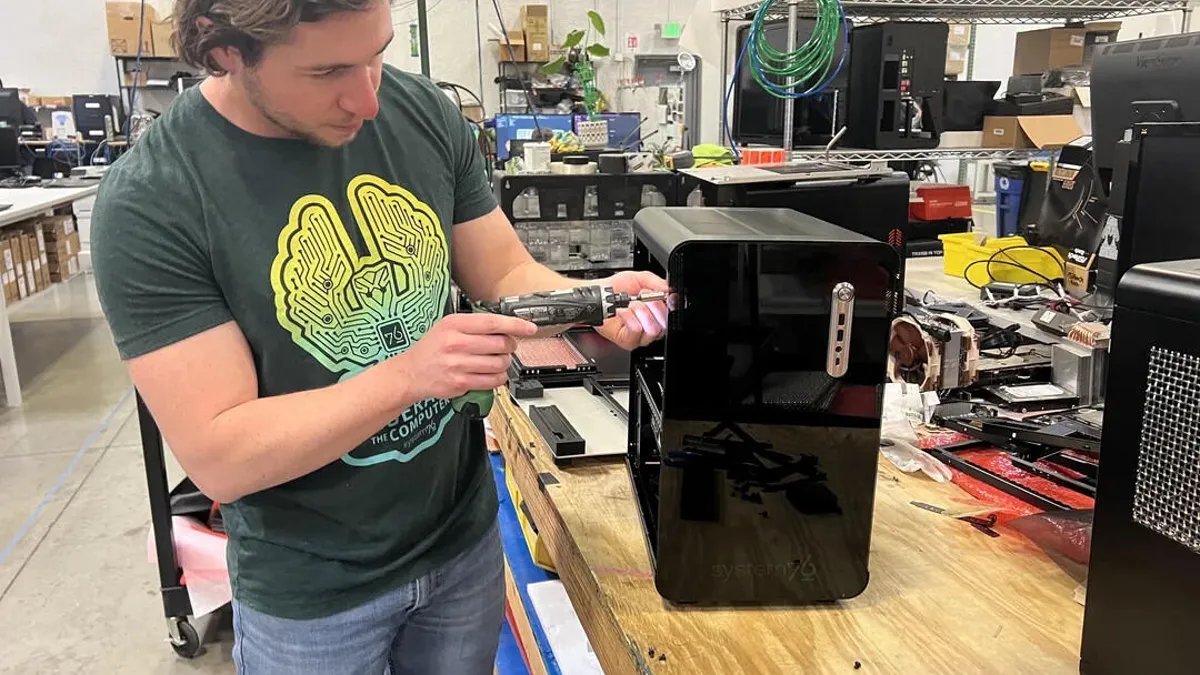
Another plus for some users, as System76 founder and CEO Carl Richell told me recently, is that the company builds its systems at its own Denver, Colorado, factory. There, the company says, its servers, desktops, and laptops are “Designed by nerds. Engineered by experts. Handcrafted by humans.”
Richell describes Mira as the “beginning of that new desktop design refresh,” a platform that lets System76 relearn thermal dynamics, structural design, and manufacturability at scale. System76 put the chassis through adhesive and mechanical torture tests — robots repeatedly pulling the side and front panels off thousands of times — to ensure the new modular construction would withstand years of use and field servicing.
The results are impressive. This system is the best-looking workstation I’ve used since the early 1990s, when I had the pleasure of using a Silicon Graphics (SGI) IRIS Indigo and a NeXTStation Turbo Color.
Pricing
The Custom configuration is exactly what it sounds like: you pick the CPU, RAM, storage, and GPU, which determines the price. The price range starts at a “serious but attainable” $1,699 and goes into the “this is my main workstation for years” $7,000-plus territory. My system specced out at about $6,500. If I were a serious programmer, an AI developer, or a professional gamer, I’d have gladly paid the money. As a tech journalist, I can’t justify the money, but I wish I could. This is one sweet system.
System76 also offers Premium and Elite preconfigured Mira variants. Still, the Custom SKU is where Linux power users and developers can tailor the machine for compile farms, serious development work, home labs, or local AI rigs without paying for mismatched parts.
You’re paying a clear premium over DIY, but your cash buys integration, thermals, and support from a vendor whose entire stack, from firmware to the operating system, is oriented around Linux.
ZDNET’s buying advice
For people like me, who’ve gotten tired of cutting their fingers assembling their own systems, System76’s new 2026 Thelio Mira Custom desktop PC is a win. Sure, I might save a few hundred bucks building and tuning the parts myself. Still, I’d never put together such a wonderful Linux-first workstation that combines cutting-edge AMD and Nvidia hardware with great looks and cooling aimed squarely at sustained, heavy workloads.
In short, this is the best Linux workstation I’ve ever seen. If that’s what you need, this is the computer you want to buy.
[ad_2]
Source link
