

[ad_1]

Follow ZDNET: Add us as a preferred source on Google.
ZDNET’s key takeaways
- MX Linux’s Xfce AHS is a Linux distro for modern hardware.
- Whether it’s a desktop or laptop, MX Linux AHS should work out of the box.
- MX Linux is free to download and install.
MX Linux is a dual adventure between the antiX and MX Linux communities and serves as a collection of open-source operating systems that are all built around the Debian Stable distribution. Because of that Debian base, MX Linux is a highly stable operating system that performs brilliantly on PCs of all types — from older systems, midrange, and powerhouse computers.
There are five different versions of MX Linux:
- MX-25.2_Xfce_x66 – The standard release that is based on Debian 6.12 with hardware support from Debian Stable and is suitable for PCs that are a few years old.
- MX-25.2_KDE_x64 – Based on the 6.12 kernel with the Advanced Hardware Support repositories enabled and defaults to the KDE Plasma desktop environment.
- MX-25.2_fluxbox_x64 – Same as the KDE version above, only it ships with a custom fluxbox desktop.
- MX-25.2_rpi_respin – A respin of the Raspberry Pi OS with an MX Linux setup, and is suitable for Pi4, Pi400, and Pi5 hardware.
There’s also a version, MX-25.2_Xfce_ahs_x64, which includes the 7.07 kernel and includes new graphics drivers and firmware. This version of MX Linux is ideal for newer systems that are 1-3 years old.
Also: CachyOS vs. MX Linux: Are you seeking speed or stability in your distro?
The MX-25.2_Xfce_ahs_x64 version ships with a Liquorix kernel that is tuned for high-performance audio and video, which makes it an outstanding option for gaming. You also get DKMS packages to ensure that modern GPUs and Wi-Fi chips work out of the box. The combination of the kernel and Mesa stack offers HiDPI scaling via XFCE at 125% and 150%, while looking crisp, and you get the MX Nvidia installer to make it exponentially easier to get the proper GPU driver installed and working flawlessly.
Thanks to the Xfce desktop, MX Linux XFCE-AHS runs with speed that’s on par (or superior) to any desktop OS on the planet. I’ve covered MX Linux several times here on ZDNET, and the OS has never ceased to impress me. It offers an old-school look and feel, but modern performance and ease.
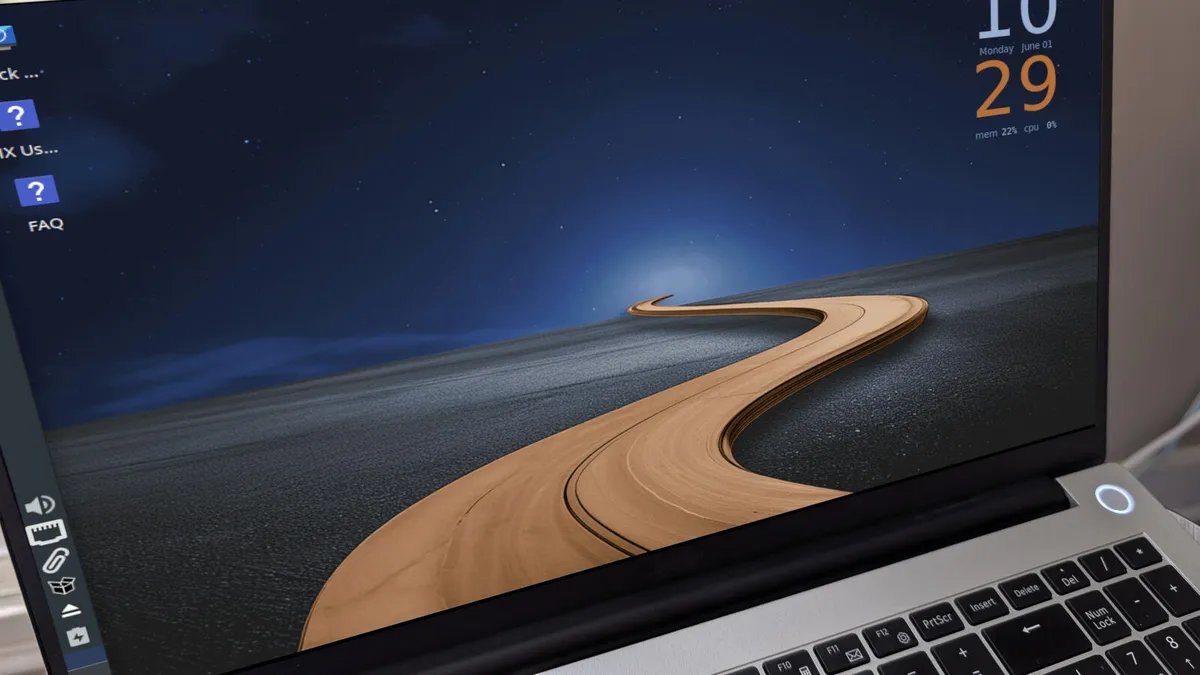
I installed MX Linux XFCE-AHS as a virtual machine, and it did not fail to impress me out of the box. Keep in mind that I’ve never been a big fan of the Xfce desktop environment, but MX Linux gives Xfce a slightly more modern look and feel with a custom layout and a nicely laid-out Conky configuration that displays the time/date and RAM/CPU usage percentage.
Also: I customized an Arch-based distro my way in under 5 minutes – and it’s glorious
The Xfce desktop environment on MX Linux AHS isn’t exactly modern, but it gets the job done.
Jack Wallen/ZDNET
You get plenty of preinstalled applications, such as Firefox, LibreOffice, Asunder CD Ripper, a handy Bash Config GUI, Catfish file search, a GUI for installing downloaded .deb packages, FeatherPad (text editor), Firewall Configuration (GUI for ufw), LuckyBackup, Thunderbird, all the MX Tools, and much more.
What makes this distro so special?
There are tons of Linux distributions vying for your attention, so what makes MX Linux AHS the one you should use?
Simply put, it’s all about new hardware. If you have a new PC and you want to make sure that the machine can work with Linux, without having to do any tweaking, MX Linux AHS is what you want. If you’re worried about Wi-Fi, sound, or discrete graphics (stand-alone graphics processors that function separately from the CPU) working properly, the combination of the Liquorix kernel, the latest MESA release, and the addition of DKMS (Dynamic Kernel Module Support), you can bet that newer hardware will work out of the box.
Also: How much RAM does your Linux PC actually need in 2026? An expert’s sweet spot
And with the Xfce desktop environment, newer hardware is going to perform exponentially better than you expect. Running with just 4GB of RAM and 2 CPUs, MX Linux AHS ran like an absolute demon as a virtual machine.
MX Linux isn’t limited to working on modern desktops. If you own a modern laptop, MX Linux 25.2 AHS was built specifically for you.
Also keep in mind that the Liquorix 7.0.9-2 Liquorix kernel (the 7.07 kernel was immediately updated after the OS was installed) is a low-latency kernel, which means it has been designed to decrease the time it takes to respond to various events, such as audio, gaming, and industrial automation.
If you’re a gamer or audio designer and are using hardware that is 1-3 years old, MX Linux AHS might be the best distribution for you. Yes, you have to deal with a slightly less-than-modern desktop UI, but the speed you gain from using Xfce is worth feeling a bit out of date on the user interface side of things.
If you wanted to, you could always install a newer desktop environment, such as KDE Plasma or COSMIC. For kicks, I installed KDE Plasma desktop with:
sudo apt-get install kde-plasma-desktop -y
I wanted to see how the KDE Plasma desktop would perform on top of the MX Linux AHS release. It took roughly a minute for the installation to complete. After a restart, I logged into KDE Plasma (Wayland version) and found it performed as well as Xfce (and even had the nice Conky on the desktop). If you’ve been reading my work long enough, you know that I prefer a modern desktop over one that looks like it was designed in the early 2000s. It’s nothing against Xfce, it’s just that I want something more up to date.
Also: Goodbye, VirtualBox – I found a better, more reliable VM manager for Linux
Now we’re cooking with gas.
Jack Wallen/ZDNET
The only thing missing from my KDE Plasma installation was the usual collection of KDE Plasma apps (such as Discover and Konsole). I was able to solve that with:
sudo apt-get install kde-full -y
Beyond the performance, I was happy to see that KDE Plasma ran flawlessly, so if you want the hardware support and low latency of MX Linux AHS, but would prefer a more elegant desktop, install this OS and then install KDE Plasma on top of it.
Who is MX Linux AHS for?
This question is simple: If you have a modern PC or laptop and you want an OS that’ll work right out of the box, MX Linux AHS should tick all the boxes. The only nit I could pick is that the OS didn’t ship with Steam preinstalled. That’s fine, as you can always install it via the command line like so:
sudo apt-get install steam-installer steam-devices -y
MX Linux AHS is a great option for anyone with modern hardware. Between the 7.09 Liquorix kernel, DKMS, and the updated Mesa stack, your hardware is most likely supported, and if you decide to install a more modern DE, you’ll wind up with an elegant, powerful, and modern PC or laptop.
[ad_2]
Source link