

[ad_1]

Follow ZDNET: Add us as a preferred source on Google.
ZDNET’s key takeaways
- Vertically positioning your monitor is an easy and effective way to enhance your workflow, as it enables you to view more content simultaneously, reducing the need to constantly scroll.
- Windows 11 allows users to rotate their screens through system settings, and third-party tools also enable display adjustments via keyboard shortcuts.
- This guide teaches you easy ways to rotate your monitor, plus gives suggests on recommended displays.
Turning a computer monitor from a landscape position to a portrait position may seem odd at first. After all, a horizontal display allows you to see more content on-screen, plus it is a more familiar experience. However, there are certain situations where flipping your screen vertically is genuinely useful.
Programmers, for example, often prefer this orientation because it lets them see more lines of code without needing to scroll. Writers, like myself, appreciate this mode, as it makes reading and creating documents easier.
Also: 12+ laptop accessories that I swear by (and how they’ve improved my productivity)
Vertical monitors can also free up physical desk space and help with multitasking. You can position web pages and apps, such as Slack, on top of each other to improve readability. I’ve seen comments online claiming that a portrait-aligned screen is ergonomically better. That might be true in some scenarios, although there is a size limit. I’ll get into it later, but first, let’s go over how to rotate your monitor.
How to rotate a monitor on a Windows 11 PC
1. Through the Settings menu
The simplest way to rotate your monitor in Windows 11 is through the Settings menu.
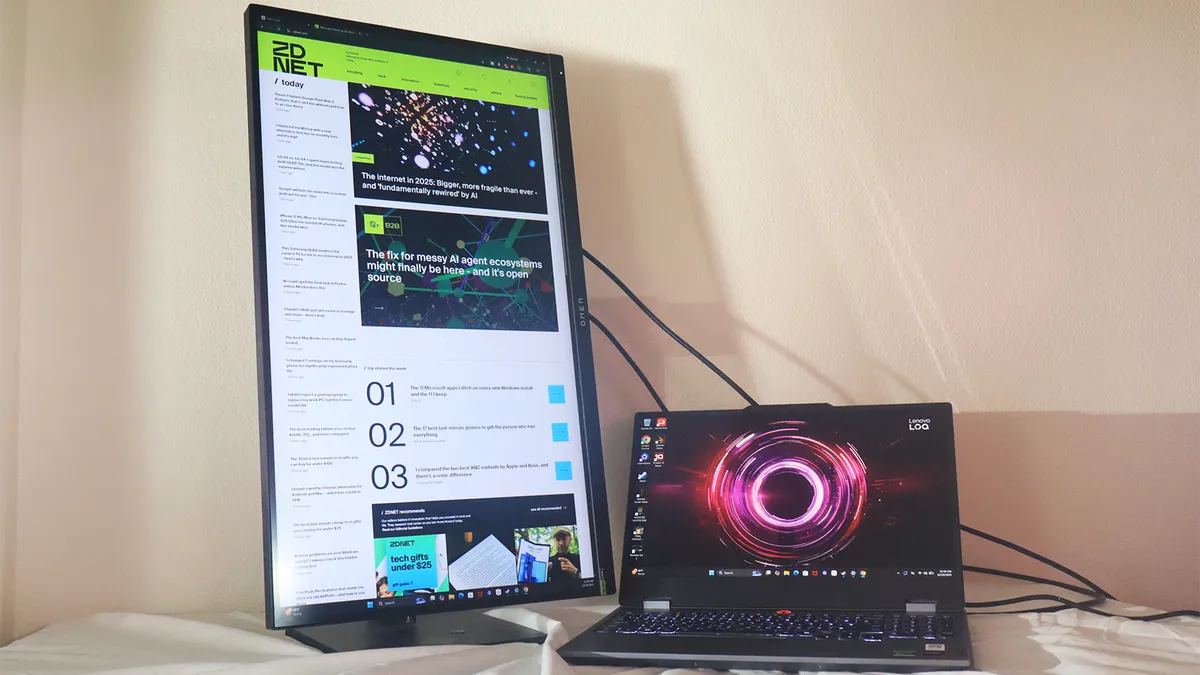
Launch Settings > System > Display > Scale & layout > click the Display orientation drop-down menu. By default, it’s set to Landscape, but you can choose Portrait to flip the screen 90 degrees to the left. There are also Landscape (flipped) and Portrait (flipped) options. The former turns the screen upside down while the latter flips the screen 90 degrees to the right.
HP Omen 27K monitor flipped to its side
Cesar Cadenas/ZDNET
When you make a change, a small confirmation window will appear asking if you want to keep the new orientation. You can either allow the changes to take effect or revert back. Additionally, if you have multiple monitors, you’ll need to select the specific screen from the top of the Display menu.
2. Through keyboard shortcuts
A limited number of Windows PCs natively support keyboard shortcuts for screen rotation. According to HP, this feature appears to be restricted to computers equipped with integrated Intel graphics cards. If you have one of these PCs in your possession, the following is a list of keyboard shortcuts that you can use to flip your monitor.
- Ctrl + Alt + Left arrow key — Flips the screen to Portrait mode 90 degrees to the left.
- Ctrl + Alt + Right arrow key — Flips the screen to Portrait mode 90 degrees to the right.
- Ctrl + Alt + Down arrow key — Flips the screen upside down.
- Ctrl + Alt + Up arrow key — Resets the screen to its original position.
HP states that if the shortcuts don’t work, you may need to enable them in your GPU’s settings. On a PC with an integrated Intel GPU, go to the Intel Graphics Settings app and look for either “Rotation” or “Orientation”. There should be an option that allows you to create custom hotkey configurations for the display.
Also: The 4K monitor that effectively changed how I work and consume content at the office
If this doesn’t work or you don’t own a PC with an integrated Intel GPU, there is a solution. Head over to the Microsoft Store and download Screen Rotate, an app that lets you rotate your screen using keyboard shortcuts. The app gives users two methods of adjustment: you can either click one of the five on-screen buttons or click the gear icon to enable the shortcuts.
The image above shows the default settings. Clicking an entry allows you to rebind the action to a different combination of keystrokes. You can’t make your own, but you do have a selection of 78 options to choose from. The main limitation of Screen Rotate is that it works on the monitor set as the primary display when the app is installed.
How to rotate a monitor on a Windows 11 laptop
The process is largely the same on laptops, with 2-in-1 devices being an exception. These devices have built-in motion sensors that detect when the device is turned and automatically adjust the screen orientation to match the new position. It is possible to stop the automatic rotation. Go to Settings > System > Display > Scale & Layout, then toggle the switch next to Rotation Lock.
Which monitors should you get?
Initially, I mentioned a size limit. If you want a monitor to place vertically for projects, you don’t want to get one that’s too big. Kevin Butler, an ergonomist at PC accessory brand Steelcase, urged people to be careful with tall screens. Butler told business website Entrepreneur that “as soon as you have to look slightly upward at your screen, your neck and shoulders go into what’s called neck extension… [which can lead] to all kinds of problems down the road.”
Also: A remote worker’s plea: Why an ultrawide monitor shouldn’t be your default choice for productivity
Symptoms of an overextended neck include limited range of motion, stiffness, and pain. Speaking from personal experience, you don’t want this. Therefore, I recommend purchasing a small monitor if you prefer a vertical screen; a display ranging from 22 to 28 inches would be ideal. Anything bigger and you’ll have to really crank your neck up.
My first suggestion would be the Dell UltraSharp 24. It is a 24-inch Full HD monitor featuring a flexible hinge that allows for 90-degree rotation to the side. And it supports multiple color spaces for a vibrant output. For gamers, check out the HP Omen 27K. It is a 4K gaming monitor that runs at a 144Hz refresh rate to ensure smooth on-screen.
It’s my favorite monitor of my time. And you road warriors, I recommend the HP Series 5 Pro Portable Monitor. This isn’t a traditional screen. To rotate it, you just flip it on its side. I tried it out myself while traveling in September, and it was a huge asset.
I have spent nearly a decade writing about consumer electronics and testing various PC setups across different environments, from office spaces to home settings. As part of my work, I often experiment with different features to see how I can improve my workflow and whether I’m able to. Rotating my screen to a vertical orientation has helped me immensely in the past, so I wanted to share my experiences — both good and bad. An upright monitor isn’t for everyone, and it may not be suitable for every situation.
My goal, as it has been since the beginning, is to provide practical advice grounded in real-world testing, so you can make informed decisions about what’s best for you. Keep in mind that these aren’t rigid rules. Think of them as a foundation you can build upon based on your needs.
[ad_2]
Source link
